|
•
History • People & Culture • Economy •
• Shop & Dine • Getting There • Travel Tips • Weather •
History
Kedah has a long history; the Bujang Valley has remains
of a Hindu-Buddhist kingdom that dates back to the 4th century AD,
making it the oldest civilization of Peninsular Malaysia. Before the sea
route around the peninsula was firmly established, trade between India
and China was conducted across the peninsular isthmus. The current royal
family can trace its line directly back to this time. The region came
under the influence of the Sumatran kingdom of Sri Vijaya in the 7th and
8th century, followed by a period during which Kedah was dominated by
the Thai states to the north. Kedah's ancient civilization waned in
importance by
the 15th century, when Malacca assumed a more dominant role.
The establishment of Islam in Kedah is due to Malacca's influence. When
Malacca fell to the Portuguese, the influence of its Sultanate over
Kedah weakened.
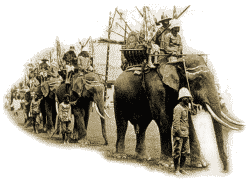 However,
other powers soon asserted themselves in Kedah, including both the
Portuguese and the rising Achenese, and by the end of the 18th century
the Thai threat arose once more. Fearing renewed domination by its
northern neighbours, Kedah appealed to the British for assistance. As
inducements to a commitment, Kedah ceded first Penang (1796) and then
the adjoining strip of coastal land (1800) to the British. However,
other powers soon asserted themselves in Kedah, including both the
Portuguese and the rising Achenese, and by the end of the 18th century
the Thai threat arose once more. Fearing renewed domination by its
northern neighbours, Kedah appealed to the British for assistance. As
inducements to a commitment, Kedah ceded first Penang (1796) and then
the adjoining strip of coastal land (1800) to the British.
Nonetheless, Kedah fell to the Thais in 1821. Thailand transferred their
sovereignty to the British in 1909. With the exception of the period of
occupation by the Japanese during World War II, Kedah remained under
British influence until independence.
The Kedah Sultanate began when the 9th Kedah Maharaja Derbar Raja
(1136-1179 AD) converted to Islam and changed his name to Sultan
Muzaffar Shah. Since then there have been 27 Sultans who ruled Kedah
People & Culture
Like Malaysia's other states, Kedah has its share of rich cultural
traditions,
songs and dances. Due to its close proximity to Thailand, some of these
traditions are Thai in influence and origin, and faces of Kehah's people
often bear signs of Thai or Achinese ancestry. The people of Kedah are
generally padi planters with most living in kampungs next to their
fields.
Kedah's population of about one million is primarily Malay, though there
are significant Chinese and Indian minorities.
The state's ethnic composition in 1995 was estimated as: 72% Malay,
19% Chinese, 8% Indian and 1% Others.
Economy
Together with Perlis, Perak, and
Kelantan, this northwest state shares a
common border with Thailand in the north. Known as the "Rice Bowl of
Malaysia", the Kedah-Perlis rice plains produce more than half of the
country's home grown rice supply. Other agricultural products, including
rubber, oil palm and tobacco are also important. Although predominantly
an agriculture-based State, the State is, shifting its economic thrust
from agriculture to industry. Industrial estates have sprung up in
Alor
Setar, Kuala Kedah, and Sungai Petani while the government has started
developing and promoting tourist facilities. Tourism, particularly on
the island of Langkawi is of growing importance.
Shop & Dine
Like Malaysia's other states, there are shops and modern malls in most
major towns, as also are the presence of western fast food outlets such
as
Mc Donald's and KFC.
Local Food
The state offers mouth-watering recipes of Kedah cuisine, which is not
only unique but also prepared fast enough to whet the appetite of
everybody. It has a wide variety of Thai, Chinese, Malay, and Indian
food to choose from. Traditional local dishes, which are favourites, are
gulai nangka, sayur keladi, and pekasam. Nasi ulam is another
local food which is prepared by blending rice with varied fresh vege's
and spices. Pulut, or glutinous rice is an old-time favourite of the
northerners and is taken with fruit such as mango, durian and even
banana. Other pulut delicacies are pulut sambal, pulut inti, and
tapai pulut. Laksa is rice noodles taken with a preparation of thick
fish gravy and cucumber, onion and shoots. Popular sweet cakes are
baulu and the dodol – a preparation of coconut, sugar, and flour.
Kuala Kedah, a busy fishing town and a jumping off point to Langkawi
Island, is famous for its ‘Laksa Kuala Kedah’, a local delicacy of thick
rice vermicelli and spicy fish gravy. Two floating seafood restaurants
converted from fishing vessels add to the town’s attraction.
The food stalls at Pantai Murni Esplanade is a great place to relish the
wide-range of local foods. Take your pick from an array of spicy
Malaysian and Kedah favourites. Your best choice would be the varied
preparations of fresh seafood such as chilli crabs, grilled squids,
fish or prawns. The breezy esplanade draws the crowd to its excellent
panorama of beautiful sunset amidst the speckle of islands beyond If you
love sea products, you may go to Tanjung Dawai, it's a fishing village.
You can find salted fish, fish crackers, salted sea food etc. sold in
the Bazaar. The Bazaar is very small. From Tanjung Dawai you can see
Pantai Merdeka.
Shopping
The famous ‘Pekan Rabu’ (Wednesday Market), consisting of many small
stalls offers a variety of products, ranging from farm produce to
handicrafts. Local delicacies and Kedah food is also available here.
Opens from morning to midnight. While in Langkawi, consider picking up something from
Langkawi Crystal. Gorgeous crystal pieces, both decorative and
functional, skilfully crafted and blown. Also look out for the famous
Langkawi Marble, with marble from the legendary Pulau Dayang Bunting.
Getting There
Being a border state with Thailand, Kedah has a border entry point
at Bukit Kayu Hitam. Malaysia Airlines flies daily into
Alor Setar and
rail services link Alor Setar with various big and small towns along the
North South track across the peninsula.
By Road
The north-south expressway has made it easy for any traveller to drive
up to Kedah. Roads are accessible from major towns and cities in the
Peninsula. It is a 7-8 hour drive from Kuala Lumpur.
From major towns, such as Kuala Lumpur and Penang, air-conditioned
express buses are also available. They service almost all towns in
Kedah.
From Alor Setar, the capital city of Kedah, one can even take the bus up
to the border of Thailand.
By Rail
The Malaysian railway (KTM) services major towns in Kedah.
By Air
The airport is located approximately 11km north of Alor Setar.
Malaysia Airlines and Air Asia flies daily to and from Alor Setar from
Kuala Lumpur via either Penang or Kota Bharu.
Travel Tips
Weekends & Holidays
It has different business hours than most of the other states. Banks and
government offices are closed on Friday. Saturday is a half-day and
Sunday is a working day. During public holidays, school holidays and the
long weekends, are peak seasons and resort bookings such as in Langkawi
may not be available, unless it is made early.
Cash & Credit Cards
Credit cards are generally accepted, except at certain small towns
and establishments. Similarly, ATM machines are also widely available
especially at the bigger towns. Cash would always be the better option.
Money changers are easily available at the popular resort island of
Langkawi and generally so at most major towns in the state.
 7 Days Weather Outlook 7 Days Weather Outlook
for
Alor Setar |

information - travel guide - places of interest |
|

